Homemade Roasted Red Pepper Spread (Ajvar)
The golden standard of Serbian preserves — homemade ajvar from roasted red peppers, rich, smoky and aromatic. Made in September, keeps all winter.
Prep
60 min
Cook
120 min
Total
240 min
Servings
10
Preparation
1. Roasting the Peppers (and Eggplant)
Wash and dry the peppers. Roast them on a grill, wood-burning stove, or in an oven at 230–250°C until the skin is charred and blistered on all sides — turn them once or twice. This takes 20–30 minutes on a grill, slightly longer in the oven. Roast the eggplant the same way.
Transfer the roasted peppers immediately to a large bowl and cover tightly with a lid or plastic wrap — the trapped steam makes peeling much easier. Leave to cool for 20–30 minutes.
2. Peeling and Cleaning
This is the most labour-intensive but most important step. Peel each pepper individually once cooled: slip off the charred skin with your fingers (it comes away easily now), fold open the pepper and pull out the stem along with the seeds. Save the juice that runs out — it’s full of flavour and goes into the ajvar. Allow the cleaned peppers to drain in a colander but do not squeeze — a little juice remaining is useful.
Peel the eggplant in the same way.
3. Grinding
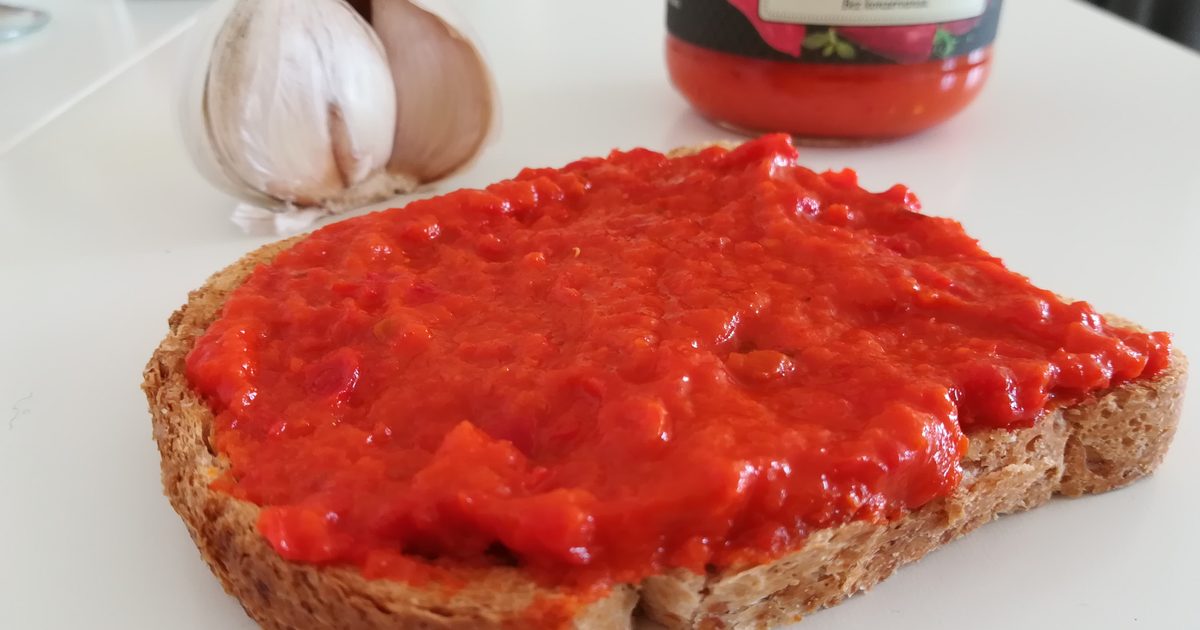
Put the cleaned peppers (and eggplant) through a manual meat grinder or blend briefly. The goal is a coarse paste — it doesn’t need to be perfectly smooth. Traditional homemade ajvar has texture, it is not a purée. If using a blender, pulse briefly and do not over-process.
4. Cooking the Ajvar
Pour the oil into a wide, deep pot (or a traditional copper cauldron) and add the ground mixture. Cook over medium-high heat, stirring constantly with a long wooden spoon or spatula. Ajvar must be stirred continuously as it sticks to the bottom.
Cook for 60–90 minutes until the ajvar loses most of its moisture and becomes thick — when you draw the spoon across the bottom of the pot, the trail should remain visible for several seconds. The colour deepens to an intense red-orange.
About ten minutes before the end, add the garlic, season with salt, add the pinch of sugar and the vinegar. Stir and cook for another 5–10 minutes. Taste and adjust as needed.
5. Filling Jars and Pasteurising
Wash the jars and sterilise them — place them wet in an oven at 150°C for 15 minutes, or boil in water. Boil the lids for 5 minutes.
Ladle the hot ajvar into hot jars all the way to the top, seal immediately and turn upside down for 5–10 minutes (this creates a vacuum). Then turn right-side up and leave to cool covered with an old blanket (slower cooling = better vacuum).
Alternatively, pasteurise the filled jars in hot water for 20 minutes.
6. Storage
A jar with a good vacuum will keep in a cool, dark place for up to one year. Once opened, refrigerate and use within 7–10 days.
Tips
Ajvar season: authentic homemade ajvar is made exclusively in September and October when peppers are ripe, meaty and at their most affordable. Serbian families organise an “ajvar day” — an all-hands family event that often lasts the whole day, frequently outdoors.
Heat level: for a spicier ajvar, add 2–3 hot chilli peppers with the bell peppers when roasting. Or stir in a teaspoon of ground hot pepper 10 minutes before the end of cooking.
Consistency: thick ajvar keeps longer and preserves better. If the ajvar remains runny, continue cooking — better to overcook than to stop too soon.
Strict fasting: ajvar made to this recipe is suitable for all fasting days that allow the use of oil (fast type “oil”). On days of strict fast (no oil), ajvar can still be spread on bread without restriction outside oil-free days.
Feast-day table: ajvar is indispensable on the fasting Slava table, especially for patron-saint days that fall during the Nativity Fast (November–January) or the Apostles’ Fast. Serve alongside fasting bread, olives and pickled vegetables.